

Feature
W.T. Preston snagboat in Anacortes, and when to see it
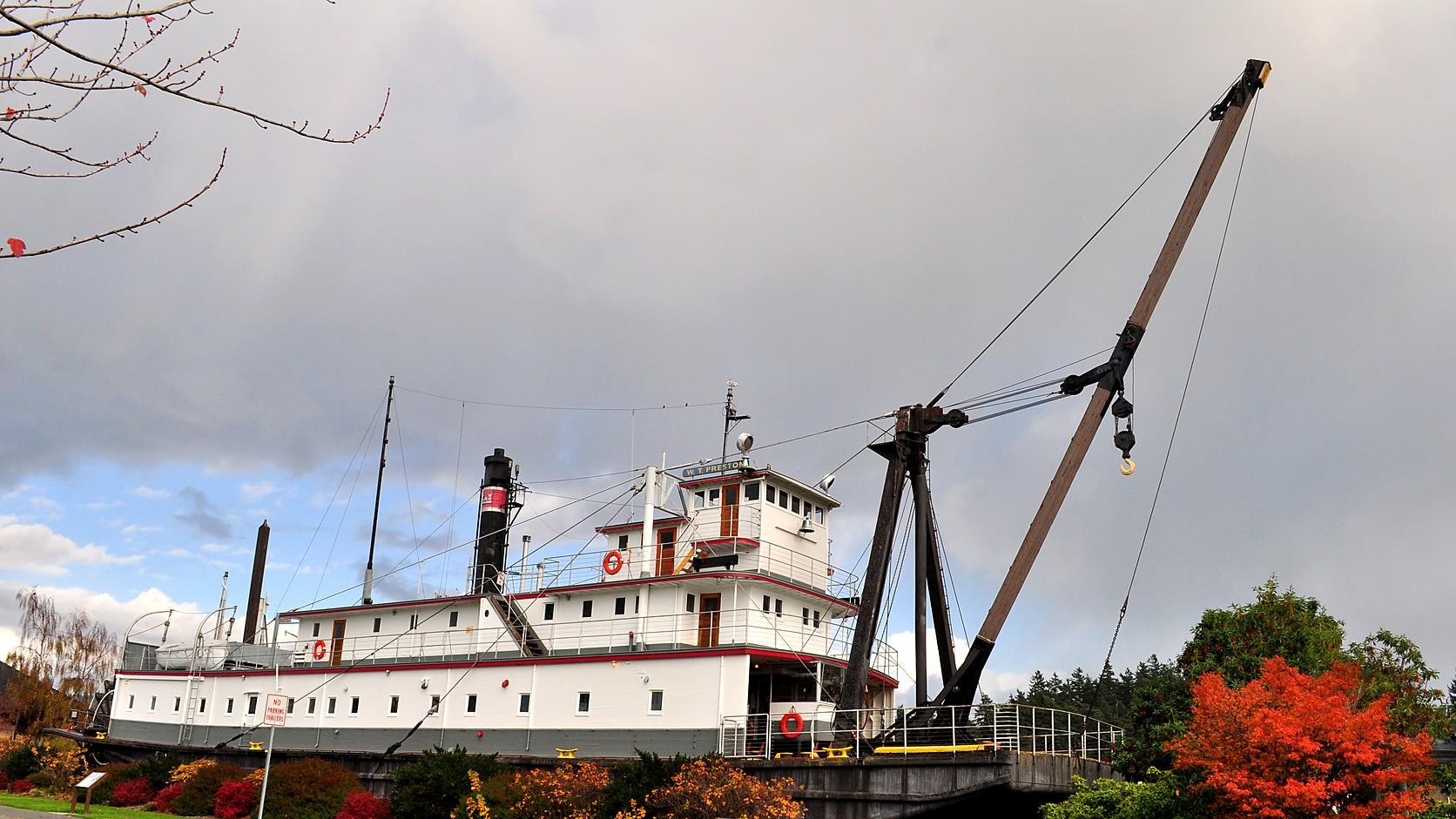
The W.T. Preston snagboat in Anacortes is listed as closed for fall and winter; the Maritime Heritage Center is open Thursday to Sunday. History and prices.
The W.T. Preston, the Army Corps of Engineers' snagboat, stands in a dry berth at 703 R Avenue in Anacortes, and its boat tours are closed for the season. As of November 2026 the City of Anacortes lists it as "CLOSED FOR THE FALL/WINTER SEASON." The city's Maritime Heritage Center next door is listed as open Thursday through Sunday, 11 a.m. to 4 p.m., free, and the city's page does not say when boat tours return, so call before a long drive from Enumclaw.
The boat you would be boarding is not the boat that carried the name when the Corps launched it. The first W.T. Preston, a wooden-hulled boat of 1929, rotted, and the Corps built a second hull in 1939. Almost everything that mattered was lifted from older boats: steam engines from 1914, a boom and a stack from the boat before that, and a steam whistle that came off the very first snagboat to work Puget Sound in the 1880s.
Can you go aboard the W.T. Preston now?
Not until the city reopens it. The city's museum page, read on November 2, 2026, gives the boat's status as closed for the fall and winter season, with every weekday and weekend row marked closed, and it prints no reopening date. The Maritime Heritage Center is the part that stays on a schedule: Thursday through Sunday, 11 a.m. to 4 p.m., closed Monday through Wednesday, no charge.
The page does not say whether the berth can be viewed from outside while the boat is shut. The photographs of it on Wikimedia Commons show the boat standing beside a public street, but that is a picture from 2013, not a statement of access. The number to ask is the museum's, 360-293-1915.
How much does a W.T. Preston tour cost?
Boat tours are listed at $7 for adults ages 17 to 64, $5 for children ages 5 to 16 and $6 for seniors 65 and up and active military, with children under 5 free when they are with an adult. Those are the prices on the city's museum page as of November 2, 2026. The City of Anacortes sets them, and they appear on that page, so a price on an older page or a travel site can be out of date; the prices on the city's page are the ones that count. Group tours are by special arrangement through the museum, at the same number.
What is a snagboat?
A snagboat is a work boat that pulls logs, stumps and wrecks out of waterways. On Puget Sound that meant "snags," trees that had fallen into rivers and drifted logs that jammed them. The first settlements in the heavily timbered parts of the state were along rivers, the city says, and the rivers served as the region's highways, so a log jam could close one. A National Park Service nomination for the Preston records two big jams on the Skagit River that held back settlement above them until the late 1870s.
The Preston did the job with a boom, a derrick mounted at the bow. The Park Service's 1988 nomination describes a 70-foot boom of laminated fir that could lift snags and debris weighing up to 70 tons. The city's specification list gives the derrick's capacity as 70 tons but the maximum snag lift as 30 tons at a 28-foot radius, and its tour guide says the boom has a 57-foot lift. Instead of an anchor she carried two steel shafts called spuds, one forward and one aft, which the city's tour guide says could be driven into the bottom in up to 20 feet of water so she held still beside a sunken object. Her crew, up to 14 men, lived aboard because the work took them far from home.
Was the W.T. Preston built in 1929 or 1939?
Both dates are right, because there were two boats. The Park Service nomination, which gives the most detailed account, says a new hull was built in 1929 and the machinery and house of the Swinomish were moved onto it. The new snagboat took the name of William T. Preston, "the only civilian ever to serve as district engineer at Seattle for the Army Corps," in the nomination's words. The city's tour guide adds that he was the Corps' chief engineering assistant in Seattle from 1896 to 1919.
After ten years the wooden hull had rotted again. The nomination says a new steel boat was built at the Lake Union Drydock in Seattle in the summer of 1939 and commissioned on January 19, 1940. The city's tour guide describes the same change as a new steel hull and upper structure in 1939. So the boat standing in Anacortes has a 1939 hull and a January 1940 commissioning, and the 1929 date belongs to its wooden predecessor. Sources that say simply "built 1929" are telling the first half of it.
One older detail has two dates. The nomination says the whistles date to 1884 and came from the first snagboat, the Skagit. The city's tour guide dates the flat-topped whistle to 1885. Both agree it is the Skagit's.
Where did the W.T. Preston work, and did it come to the White River?
The city says she worked as far north as Blaine and as far south as Olympia and Shelton, eleven months of the year, and hauled up what the city counts in the thousands: snags, pilings and floats, plus an airplane that had been damaged, fishing boats, abandoned scows and houseboats. The Park Service adds that during the Second World War she built nets to protect the Lake Washington Ship Canal dam and locks from floating bombs sent downstream, and that she was laid up from 1943 and returned to service in 1946.
No source found for this article puts the Preston on the White River, so this page does not say she worked it. What the nomination does say is that the Corps' river work was not only snagging: it describes "dredging and flood control activities" as part of the same duty. That is the thread back to the plateau. The Corps finished Mud Mountain Dam on the White River upstream of Enumclaw in 1948, as the Mud Mountain Dam guide reports, and its gauge there sets the four flood phases explained in the guide to Enumclaw flooding and the White River's phases. Snagboats and dams were different tools of one agency, working different problems on the same Puget Sound rivers.
The first of the line, the Skagit, began with an 1882 appropriation of $20,000 and went to work on the Skagit River in 1884, by the nomination's account (the city's landmark page says 1885). The Skagit is also the river where bald eagles gather in winter.
How did a Corps steamboat end up in Anacortes?
The Corps retired the Preston on October 22, 1981, because of budget constraints, according to the Park Service nomination, and put her up at its facilities at the Hiram M. Chittenden Locks, the Ballard Locks, whose winter hours are in the Ballard Locks guide. The Corps asked for proposals to preserve her, and the city says it was impressed by Anacortes's plan. The Corps transferred title in March 1983.
Anacortes set aside $40,000 to prepare a waterfront site beside its old Great Northern Railroad Depot. Towed to Anacortes and taken out of the water, the boat made her last trip over land on June 22, 1983, to the berth where she sits now. The Park Service nomination says she was listed on the National Register of Historic Places on March 16, 1972, although the city's page gives 1979, and the National Historic Landmark designation followed in 1989. The city's own description of her is "the last sternwheeler to work in Puget Sound," and the nomination calls her the last of what had been several hundred sternwheelers on the Sound and its tributaries. It also counts her as one of only two Corps snagboats that survive in the United States, and the only one in the West.
What is it like inside?
The city's self-guided tour sheet is the best preview. The tour starts in the engine room, climbs to the Texas deck with the smokestack, the captain's office and the pilot house, and finishes on the forward deck under the snagging gear. The sheet warns that thresholds are high and the ladders steep and narrow, asks visitors to go up the starboard ladders and down the port ones and to stay on the tour path, and says to keep your ticket stub if you want to re-enter.
The crew's bunks were two to a room, which the sheet says are six feet long even though they look small. In the pilot house the sheet notes how little modern navigation equipment there was: a VHF radio and a wind gauge, with the rest done by sight, charts and compass. Those details, and the inherited furniture, are why the nomination says the boat looks as if the crew had just gone ashore between jobs.
Before you go
Check the city's museum page and call 360-293-1915 for the boat, and 360-299-4130 for the Maritime Heritage Center. The Center's hours and the boat's season are set by the City of Anacortes Museum and can change with the season, so read the "current hours" lines on the day. The Center's exhibit on Don Hume, an Anacortes High School alum of the Class of 1933 and a figure in The Boys in the Boat, is on the city's page, which is another reason to go in winter.
A trip to Anacortes also puts Deception Pass State Park within reach. The page does not give a drive time from Enumclaw, so check a mapping service for the route and the day's traffic.
The reopening date, once the city posts it, should appear on the same museum page. Until it does, the answer to "when" is the one the city has printed: boat closed, Center open Thursday to Sunday.
Story label: Original Story or Guide
Originally published: