

Feature
Black Diamond Cemetery ghost stories and the mine beneath it
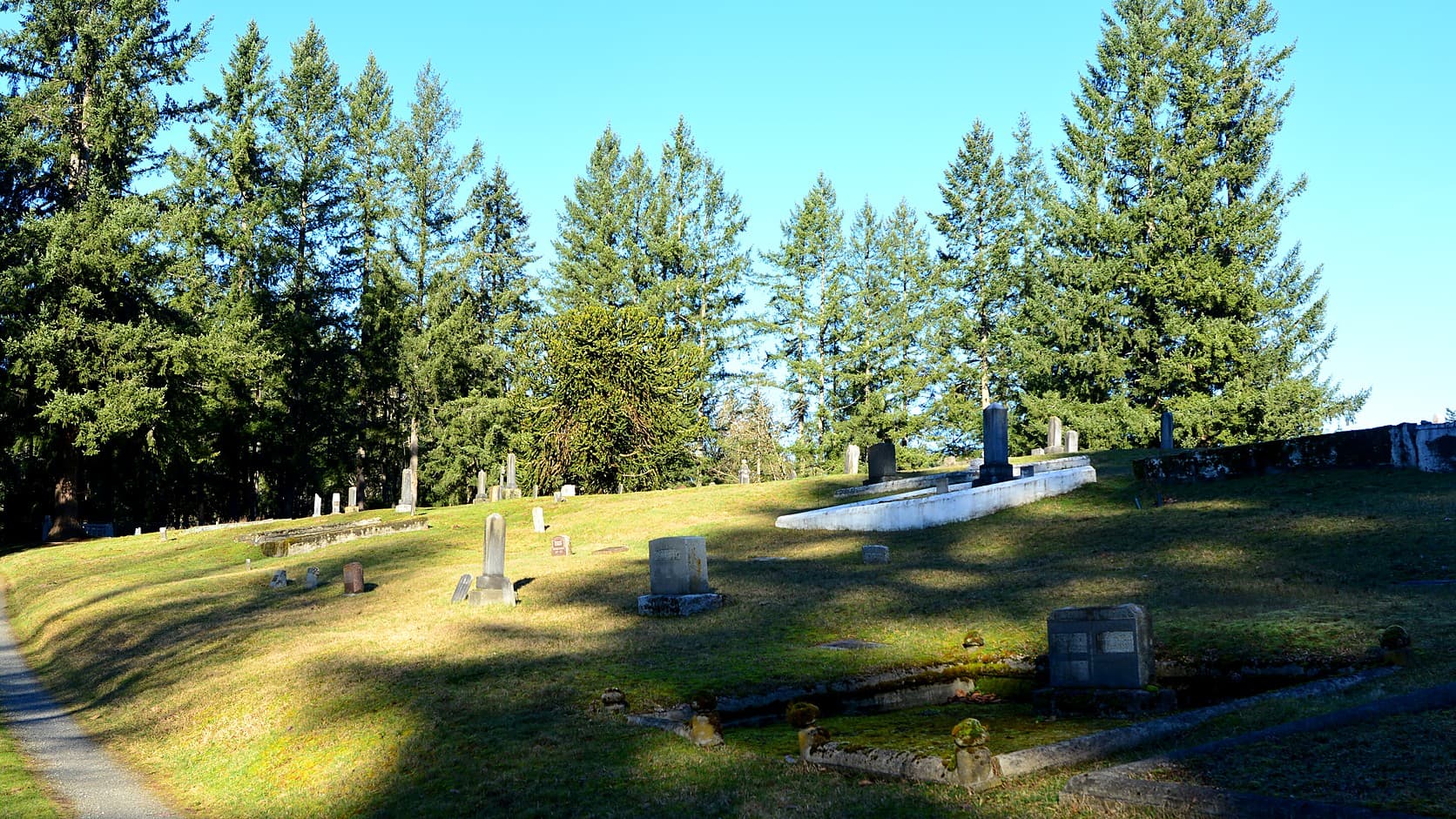
Black Diamond Cemetery near Enumclaw: who is buried there, the 1910 mine graves, the coal tunnels under the hill, the ghost stories and how to visit.
Black Diamond Cemetery is the city-owned hilltop burial ground of the old coal town of Black Diamond, Washington, at 24431 Morgan Street, about 8 miles by road north of Enumclaw. It has been in use since the mid-1880s, holds more than 1,200 graves by a 2007 count the city still publishes, and has been on the National Register of Historic Places since April 21, 2000. The Black Diamond Historical Society says it is open to the public. The ghost stories that put it on lists of Washington's most haunted places are unverified legends.
One of them concerns a light: the lanterns of dead coal miners, said to swing among the stones on foggy nights. The record has lights in it too. In a 2010 account of the 1910 Lawson Mine explosion, written for the Black Diamond Historical Society, Ken Jensen quoted Cecil Gwylm Robinson's memory, from a 1988 local history, that the dead were buried as fast as they were brought out. "They buried them even at night. From our front porch we could see them going to the cemetery with the torch lights." The horse-drawn hearse, says the cemetery's National Register nomination, "could be fitted with kerosene lamps for night processions." And by 1920, the same document says, the town's first coal mine ran inside the cemetery hill, "directly below the town cemetery."
Where is Black Diamond Cemetery, and how far is it from Enumclaw?
The cemetery is at 24431 Morgan Street, on Cemetery Hill Road, half a mile northwest of the old business district on Railroad Avenue. From Enumclaw it is about 8 miles and 15 minutes by car, according to a routing engine run for this article: north on State Route 169, then left on Railroad Avenue, which becomes Morgan Street. As of October 2026, the city lists no fee or permit for visitors. It is still a working cemetery, with plots and niches sold through City Hall.
How old is Black Diamond Cemetery?
It dates from the mid-1880s; the city and the historical society say 1884. The nomination, prepared in 1999 by Katheryn H. Krafft, then King County's landmark coordinator, says the Black Diamond Coal Company acquired the hillside about 1882, possibly from Timothy Morgan Sr., a homesteader. William Kombol's biography of the mine superintendent, Morgan Morgans, on HistoryLink says he donated the cemetery. The company had moved north from Nortonville, California, with many of its miners, the story behind how Black Diamond got its name.
The oldest date the nomination found on any marker, February 10, 1880, is a girl's, on a family stone that also records her father's death in Mine No. 14 in 1893. There was no town yet in 1880, and the nomination suggests she was reburied. The first burial after the town's founding appears to be David J. Davis, on March 25, 1886. By 1900 Black Diamond had about 3,500 people, the largest community in King County outside Seattle, the nomination says.
Who is buried in Black Diamond Cemetery?
Coal miners and their families, the Welsh and English first. The oldest graves, at the top of the hill, are mostly theirs, the nomination found, and nearly 40 epitaphs belong to Welsh or English families. Italian names are rare before 1910 and far more common after the town's Catholic church went up in 1911; the nomination suggests earlier Italian dead may have been buried near a Catholic church elsewhere. Finnish, Austrian, German and Slavic graves are mixed in, with no sections for nationality, church or lodge. Carved lambs mark children's graves, and some Italian families made their own markers.
On the south side of the Llewellyn family monument, a verse from about 1900 remembers Idris, a beloved son, who was 20, by the city's burial index. Its fifth line reads, "Speak to us across the darkness."
Is there really a coal mine under Black Diamond Cemetery?
There was, by the nomination's account. No. 14, Black Diamond's first mine, opened in 1884 with its entrance a mile from the cemetery and closed in 1917, the same document says. By 1920 its fifth and sixth levels, the horizontal tunnels a slope mine drives off its main incline at successive depths, lay inside the cemetery hill beneath the graves. Coal mining outlasted the company town by decades: the John Henry mine, an open pit outside Black Diamond, dug coal from 1986 to 1999.
Which mine disasters are remembered in Black Diamond Cemetery?
Like Carbonado's cemetery, with its row of 1899 explosion dead, Black Diamond's holds mine workers killed in explosions in 1902, 1910 and 1915, the city's cemetery page says. Evan J. Thomas was killed in a mine accident on December 7, 1895, at 54, and the company gave his widow free rent and coal for life. Four markers, two with Finnish inscriptions and one each in English and Italian, appear tied to the Lawson Mine explosion of October 1, 1902, which killed 11 men, the Seattle Post-Intelligencer reported.
The deadliest in Black Diamond's own mines was the Lawson Mine explosion of Sunday, November 6, 1910, which killed 16 men, by HistoryLink's account of the state mine inspector's report; five were never brought out. A week later, the Seattle Daily Times reported, "Eight caskets were lowered into one grave while almost the entire population of the town looked on." The nomination, written 89 years later from the markers, describes possibly as many as eight graves near the flagpole rather than one, three of them under a group monument in Italian. The city's burial index lists three Lawson victims, Alberto Fontana, 24, and Ferdinando and Isidoro Godini, 24 and 22, as sharing one stone.
Ravensdale's mine exploded on November 16, 1915, killing 31 men by HistoryLink's count, and the Gracie Hansen Community Center story tells what it did to that town. The nomination dates the blast November 15 and counts two of its dead in the cemetery, both 26, while the burial index lists five men who died on November 16, 1915, among them Edris Morgan, a track layer on HistoryLink's roster. Several young men were buried in 1894, the year of the fire at Franklin, the ghost town in the Green River Gorge; whether any died in it, the nomination says, is not known.
How Black Diamond buried its dead
Funerals in the company town were open-casket, often held at home or in the one church that served every denomination until 1911. One of the town's bands often led the procession, the nomination records, and the church bell tolled until the glass-walled hearse, drawn by horses, reached the cemetery. When a child died, the whole school marched. The only known early photograph of the cemetery, from about 1920, shows a picket fence with a hearse gate and a stile, wooden steps that let people on foot climb over while the neighbors' horses and cows stayed out.
The miners paid for it out of their wages. In February 1921 each man on a seven-page Cemetery Fund list had $2 deducted from his pay, and the year's deductions came to $910. From about 1948 to 1970 the sexton, the man who digs the graves and oversees burials, was Jack (John C.) Jones, who kept the place going on donations; the city took over in 1977.
Is Black Diamond Cemetery haunted?
Its ghost stories are unverified legends. They were in print by April 2002, when the Courier-Herald reported claims of lantern lights on foggy nights, a white horse among the headstones and whistling miners. Ghost websites repeat them; one, Haunted Places, says its stories are user-submitted and makes no claim they are accurate.
When Cascadia Paranormal Investigations spent a night there in October 2020, Seattle Weekly reported, the group's first hour went to ordinary causes. Its founder, Kyle Richmond, found electronic candles glowing faintly beside graves that could pass for lanterns on a foggy night, others found pinwheels that wind could set whistling, and the horse, the paper allowed, could have been a real one loose from some Plateau pasture. "There is no such thing as an actual ghost detector," Richmond said. No record found for this article says where the lantern story began, and none is offered here.
Can you visit Black Diamond Cemetery at night, or bring a dog?
Leave the dog at home: the city's cemetery bylaws say no animals are allowed. On night visits the city's pages are silent: it posts no visiting hours, though the bylaws ban overnight camping and glass containers. Under RCW 68.56.010, willfully damaging or removing a marker, fence, tree or plant in a cemetery, or interfering with a funeral, is a gross misdemeanor, punishable by up to 364 days in jail, a $5,000 fine or both. The bylaws limit burials to weekdays between 9:30 a.m. and 2:30 p.m.; a Saturday burial is a special service that city staff must approve. For hours or permission, call City Hall at 360-851-4500 or Public Works at 360-851-4446.
Before you go
The Black Diamond Historical Society set a free guided tour of the cemetery for Saturday, October 17, 2026, from 1 to 2 p.m. The society lists its tours on its online events calendar, and in both 2025 and 2026 it scheduled them for June, August and October; for later dates, check the calendar or call 360-886-2142. Its museum, in the old depot at 32627 Railroad Avenue, keeps burial records and helps with family research; the society posts its hours on its website, which in October 2026 listed Thursdays from 9 a.m. to 2 p.m. and weekends from 11 a.m. to 3 p.m., with free admission. To find a grave, use the interactive map on the city's cemetery page, which searches by name, year or lot. Go in daylight, and give any funeral room.
Story label: Original Story or Guide
Originally published: