

Feature
Ghost towns in Washington you can visit, and ones you can't
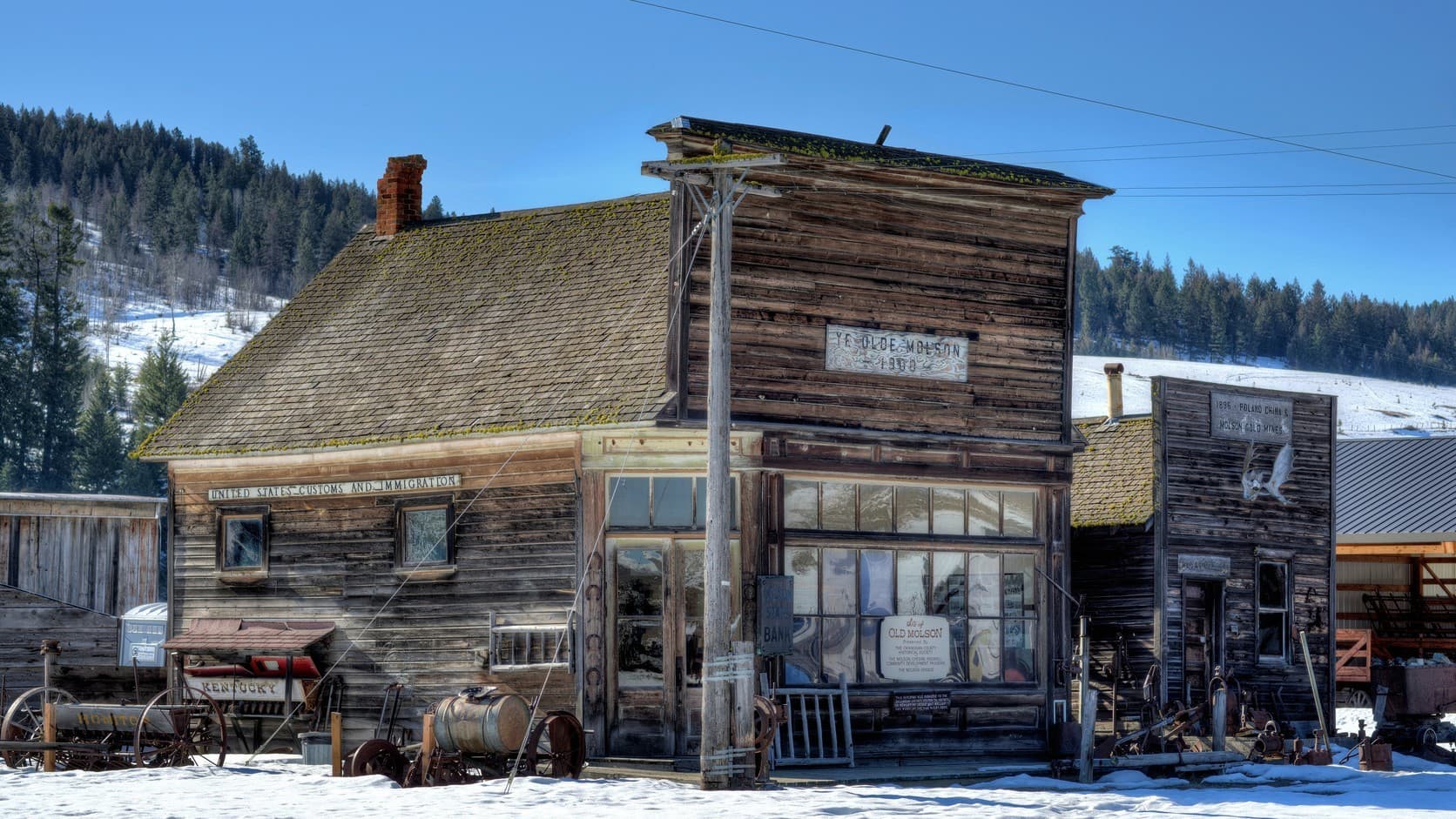
Ghost towns in Washington you can visit, from Franklin and Melmont near Enumclaw to Molson, with fees and access rules, plus the ones closed to the public.
These six Washington ghost towns can be visited as of October 2026, listed nearest to farthest by road from Enumclaw: Franklin, outside Black Diamond; Melmont, about four miles on foot from Carbonado; Liberty, a gold camp with residents; Monte Cristo, four miles on foot past Barlow Pass; Govan, whose abandoned schoolhouse near Wilbur is viewed from the road only; and Molson, an outdoor museum near the Canadian border. Four others within 25 miles of Enumclaw as the crow flies, Lester, Hot Springs, Barneston and Fairfax, are closed to the public or cut off.
Two cities' drinking water keeps three of them off limits. Lester and Hot Springs sit in the Green River watershed, Tacoma's main water supply since 1913. Barneston stood in Seattle's Cedar River watershed until the city, in HistoryLink's words, "sought to remove all human habitation from within the watershed"; its last resident left on December 31, 1923. Fairfax was cut off in April 2025, when the state closed the Fairfax Bridge, on the only public road to it, to cars, bicycles and walkers alike.
1. Franklin, eight miles from Enumclaw
Franklin, about 8 road miles from Enumclaw, is a 2.5-mile round trip on an old railroad grade with about 200 feet of climbing, by the Washington Trails Association's count. The Green River Gorge town had more than 1,000 residents at its height, HistoryLink says. On August 24, 1894, 37 miners died fighting a fire in the Oregon Improvement Company's mine, and a coroner's jury found it had been set deliberately by persons unknown; this site has told the story of Franklin and its 1894 mine fire. By 1922 the mining was over and the town mostly deserted.
The association lists a coal car bearing the town's name, a powerhouse foundation, a cemetery and a mine shaft more than 1,000 feet deep, sealed with a grate. The old railroad grade, the cemetery and the shaft were part of a land and conservation easement sale to Washington State Parks that closed in April 1973, HistoryLink says. The trail starts on private land, where, by the association's listing as of October 2026, the landowner charges $5 a person to park on a field just before the Green River Gorge Bridge. The field is private and may be closed when you arrive, and there is no street parking nearby. Pair it with the paid waterfall walk across the bridge.
2. Melmont, a hike from Carbonado
Melmont is about four miles on foot from a trailhead in Carbonado, the old coal town, about 11 road miles from Enumclaw. The Northern Pacific Railway's coal subsidiary began opening mines there in 1900 and named the company town for the men then running the railroad, president Charles Sanger Mellen and vice president Daniel Scott Lamont, HistoryLink says. Its school burned in 1905 and, rebuilt, again in 1906. The Tacoma Daily Ledger, as HistoryLink quotes it, offered a motive: "there are some who strenuously object because their children have to climb a hill." The school's foundation is still up the hill.
HistoryLink has the railroad's company leaving in 1915; a 2020 archaeology thesis on nearby Fairfax says 1918. Carbon Hill Coal worked the mines until 1919, and a fire in the 1920s took most of the rest, leaving a powder house, a bridge abutment and a grassy field. The trail association says the townsite is on White River School District property and that Pierce County Parks owns most of the rail grade.
With the Fairfax Bridge closed, the association says, the way in is from Carbonado: a gravel lot on the right just past Pershing Avenue, with no overnight parking. It puts the round trip at 7.6 miles with about 400 feet of climbing, lists no pass and warns of a mud pit, bad most of the year, just past the old dynamite shed, shortly before the fork to the townsite.
3. Liberty, the gold camp people still live in
Liberty is about 102 road miles from Enumclaw, on Liberty Road off US 97, 12 miles south of Swauk Pass. Gold in nearby Swauk Creek started it as one of several 1870s mining camps, the Bureau of Land Management says, calling it the oldest mining town site in Washington State. The bureau says it was renamed Liberty in 1916, though the trail association's history has the miners choosing the name after a post office opened in 1892, and it has been a National Register historic district since October 15, 1974.
The trail association describes historic buildings, interpretive signs and old mining equipment, asks visitors to respect the residents' private property, and lists no fee or pass. The bureau's Liberty Recreation Site, a mile up Liberty Road on Pine Gulch Road, has 15 campsites, free as of October 2026, and is open all year, though snow can close its gravel roads.
4. Monte Cristo, four miles past Barlow Pass
Monte Cristo is about 104 road miles from Enumclaw to Barlow Pass on the Mountain Loop Highway, then a four-mile walk along a road gated to cars, on the old railroad grade, by the Forest Service's account; about a mile in, the agency warns, there is no bridge over the South Fork Sauk River, and it is the turnaround for many. Joseph Pearsall staked the first claim in 1889, news of Rockefeller money behind the strike drew thousands, and the railroad arrived in 1893, HistoryLink says. At Christmas 1920 an avalanche off Toad Mountain smashed a mine entrance: "Putting on packs and snowshoes, the last four miners walked out." A flood on December 26, 1980, washed out the road.
The Forest Service's Monte Cristo page requires a recreation pass at the Barlow Pass trailhead; as of October 2026 the agency charges $30 a year for the Northwest Forest Pass and $5 for a day pass. Some land along the Sauk River is private, with patented mining claims and summer cabins. Bring water: "Surface water in the area has been found to contain arsenic and other heavy metals in amounts that exceed drinking water standards." The highway opened fully for the season on May 15, 2026, Snohomish County says, but each winter it closes to cars at the Deer Creek Gate, short of Barlow Pass, in recent years in November. The walk is still allowed then.
5. Govan, the schoolhouse near Wilbur
Govan, about 227 road miles from Enumclaw between Wilbur and Almira in Lincoln County, is known for one building. The town began in 1889 as a Central Washington Railway stop, Source ONE News reported in December 2025. Its two-teacher school was built in 1905 and closed in 1942, when Govan was consolidated with the Wilbur district, the Inlander says. A fire in 1927, which Source ONE traces to a Northern Pacific crew's controlled burns, took most of the town, and in 1933 a new highway bypassed it, both outlets say.
The schoolhouse is a favorite of photographers and is coming apart. In 2024 the Inlander reported its wood rotting, its roof letting in the weather and the bell tower over its entrance collapsed sometime in the previous decade. Look and photograph from the road.
6. Molson, the outdoor museum near Canada
Molson, about 294 road miles from Enumclaw and 15 miles northeast of Oroville, is the only town on this list run as a museum. Molson Museums keeps Old Molson Ghost Town, open in daylight, and the Molson Schoolhouse Museum, open 10 a.m. to 5 p.m. daily from Memorial Day to Labor Day. As of October 2026 neither charges admission; both take donations. Their website lists Old Molson as open year round in one place and April to November in others, and the museums do not plow, so the old town is likely to be snowed in during the winter. Call 509-485-3292 before driving that far.
By the museums' own history, a promoter, George Meacham, founded the town in 1898 (though Wikipedia and the sign on the old bank say 1900) with money from John W. Molson of the Canadian brewing family but never registered title to the land. A local man named MacDonald did, and told everyone they were trespassing. A second Molson went up half a mile away, and the feud over which was the real one lasted two decades. The post office was stolen while the postmaster was at lunch; the bank, built on skids, moved from lot to lot until it ended up in the new town.
Which ghost towns near Enumclaw are closed to visitors?
Lester, 23 miles east of Enumclaw as the crow flies, was a Northern Pacific town on the upper Green River; its school district ended up in Enumclaw's. Tacoma set out in the 1960s to shut it down to protect its water and had bought the land under it by 1969, the Washington Trails Association says; the last resident died in 2002. The association warns that the townsite is closed to public access and visitors may be ticketed. Hot Springs, a few miles downriver, once had a resort; the state Department of Natural Resources' record of its spring says the area is now reserved for Tacoma's water supply and, citing a 1960 source, that visitors are banned. Tacoma's utility limits entry with gates and guards, and the watershed's water reaches the city through a pipeline under Enumclaw.
Barneston, 14 miles from Enumclaw as the crow flies, on the Cedar River, was a mill town where about 35 percent of the workforce was Japanese, against 5 to 10 percent in the region's timber industry, HistoryLink says. Its buildings were razed in 1924, and Seattle still describes the Cedar River Municipal Watershed as closed to public access. Selleck, a lumber town on the watershed's edge, survived.
Fairfax, 13 miles south as the crow flies, is public land; Pierce County Parks manages about 1,700 acres in the Carbon River corridor, the townsite included. It had 60 coke ovens and, from 1917, a school with a gym and a heated swimming pool, whose foundation remains, HistoryLink says. In that account, the work there ended by 1930; the 2020 thesis dates the town's abandonment to 1941, when a lumber company pulled out. WSDOT's bridge closure covers walkers too, and its nine-mile detour is for first responders and property owners south of the bridge, not the public.
Is it legal to take things from a ghost town?
Leave everything where it lies. Washington law, RCW 27.53.060, makes it unlawful on public or private land to dig into an archaeological site or remove objects from one without a permit from the director of the state Department of Archaeology and Historic Preservation, and disturbing a historic grave is a class C felony. Its exception for loose surface finds does not cover places listed in or eligible for the state or national historic registers. Federal rules forbid digging in, disturbing or removing historic artifacts on national forest land, Monte Cristo included. An archaeologist who excavated at Fairfax under a state permit in 2018 found the site "moderately impacted by looting activities," with hand-dug pits across the old town.
Before you go
On the day, check each place with whoever runs it: Snohomish County's road closures page for the Mountain Loop Highway, the Forest Service's Monte Cristo page, the Molson museums by phone and the Bureau of Land Management for snow at Liberty. At Melmont, park where signs allow and stay off the Fairfax Bridge. Stay out of mine openings and old buildings everywhere.
Story label: Original Story or Guide
Originally published: