

Feature
Things to do in Roslyn, Washington, a former coal town
Things to do in Roslyn, Washington: the museum, cemeteries, the 1892 mine disaster graves, the Brick and the Coal Mines Trail, with the hours each page gives.
Roslyn is a former Northern Pacific coal town on the east slope of the Cascades in Kittitas County, and a visitor can see seven things there: the Roslyn Museum, the cemetery complex on Memorial Road, the graves of the 1892 mine disaster, the National Register historic district, the Brick Saloon, the Coal Mines Trail and the streets that stood in for Alaska on Northern Exposure. As of November 2026 the museum's schedule page lists Friday to Sunday, 11 a.m. to 3 p.m., but it is worded for spring and never mentions winter, so anyone driving over from Enumclaw should phone 509-649-2355 first. The cemeteries, by their keepers' own rule, are open in daylight hours.
The oddest thing in town is how its dead are filed. The Roslyn Cemetery Legacy Association counts 27 separate but adjacent cemeteries, many of them lodge or immigrant communities, and its history page says Black residents were excluded from the original town cemetery and buried in an adjoining piece of ground. HistoryLink puts Roslyn's Black population at about 22 percent in 1900, and about 40 percent of the town was foreign born. The ground still keeps those lines.
1. Roslyn Museum, 203 W. Pennsylvania Ave.
The museum is a local history museum at 203 W. Pennsylvania Avenue, and its own pages are the only source for when it opens. Its schedule page, read on November 2, 2026, gives Friday, Saturday and Sunday from 11 to 3 and asks for a donation of $3 per person or more. It also says "Feel free to call 509-649-2355 to confirm open hours." Because the page opens with "Roslyn Museum is opening for spring," treat the hours as a spring schedule and the phone call as the real answer for November through March. The operator sets the hours and the donation, so recheck both on the morning you go.
Inside, by the museum's account, are the Ausburg clock and other Northern Exposure memorabilia, and its scavenger hunt page pictures objects from household tools to mining gear. The museum also posts a printable scavenger hunt of its objects, including a tool called a sprag that, by the page's wording, a rope rider used to stop mine cars rolling down the slope of the tipple to be dumped into railroad cars.
2. The Roslyn cemeteries on Memorial Road
The Roslyn cemeteries are open to the public in daylight hours, and the Legacy Association asks for respectful visitation. Its home page says "Open to the public during daylight hours for respectful visitation." The association gives the address as Memorial Road, Roslyn, WA 98941, while the museum's directions say Memorial Drive. Those directions from I-90 are exit 80, then Bullfrog Road to State Route 903 and Pennsylvania Avenue west, up the hill to Fifth Street and a left onto Memorial Drive.
How many cemeteries there are depends on who counts. The association says 27. The 1978 National Register nomination says 26 within about twelve acres, and HistoryLink says 25. The association's history page explains how the number grew: one general cemetery (now called Old City) came first, then fraternal organizations opened their own, and the city was deeded the land in 1926. Most of those lodges have long since disbanded, and the association says families and volunteers do most of the cleaning and maintenance. The association's home page describes it as a nonprofit and has a donation button.
3. The 45 miners of May 10, 1892
Roslyn's worst day came underground. HistoryLink says gas and coal dust ignited on May 10, 1892 in the No. 1 mine of the Northern Pacific Coal Company, as crews worked to link an airway with a deeper level, and 45 men died. It remains the worst coal mine disaster in Washington history, and it left 29 new widows and 91 orphans, by HistoryLink's count.
The association's 1892 page lists all 45 names, including several father and son pairs, and tells visitors how to find the graves: open the Grave Locator Kiosk, search "1892 mine disaster," and download the map with plot numbers for anyone buried in Roslyn. The association's own site carries a searchable Grave Locator Kiosk database at roslyncemeteries.org/grave-locator-kiosk, so the names can be searched before the drive; the 1892 page does not say where the on-site kiosk stands or whether it works in winter, and that was not verified for this article.
4. The Roslyn Historic District downtown
The downtown sits inside the Roslyn Historic District, which was listed on the National Register of Historic Places, and the National Park Service's record gives the publication date as February 14, 1978. The nomination says the boundary takes in the whole built-up town, the cemeteries southwest of it and an industrial open space to the east, and that the town's fabric from about 1890 to 1930 is largely intact.
Why so much brick? A fire on June 22, 1888 destroyed the entire business district, by HistoryLink's account, and Roslyn rebuilt with more brick. At the corner of Pennsylvania Avenue and First Street the 1978 nomination found brick buildings on three corners, including the Northwestern Improvement Company Store, 284 feet long and 88 feet wide, built in 1889 by the Northern Pacific Coal Company. The nomination called it the last remaining structure tied to the Roslyn coal field and said it was then being restored, so what it houses was not checked. In 1919 the writer W. D. Lyman, quoted by HistoryLink, described a town like "a section of another world, accidentally dropped down."
5. The Brick Saloon, 100 West Pennsylvania Avenue
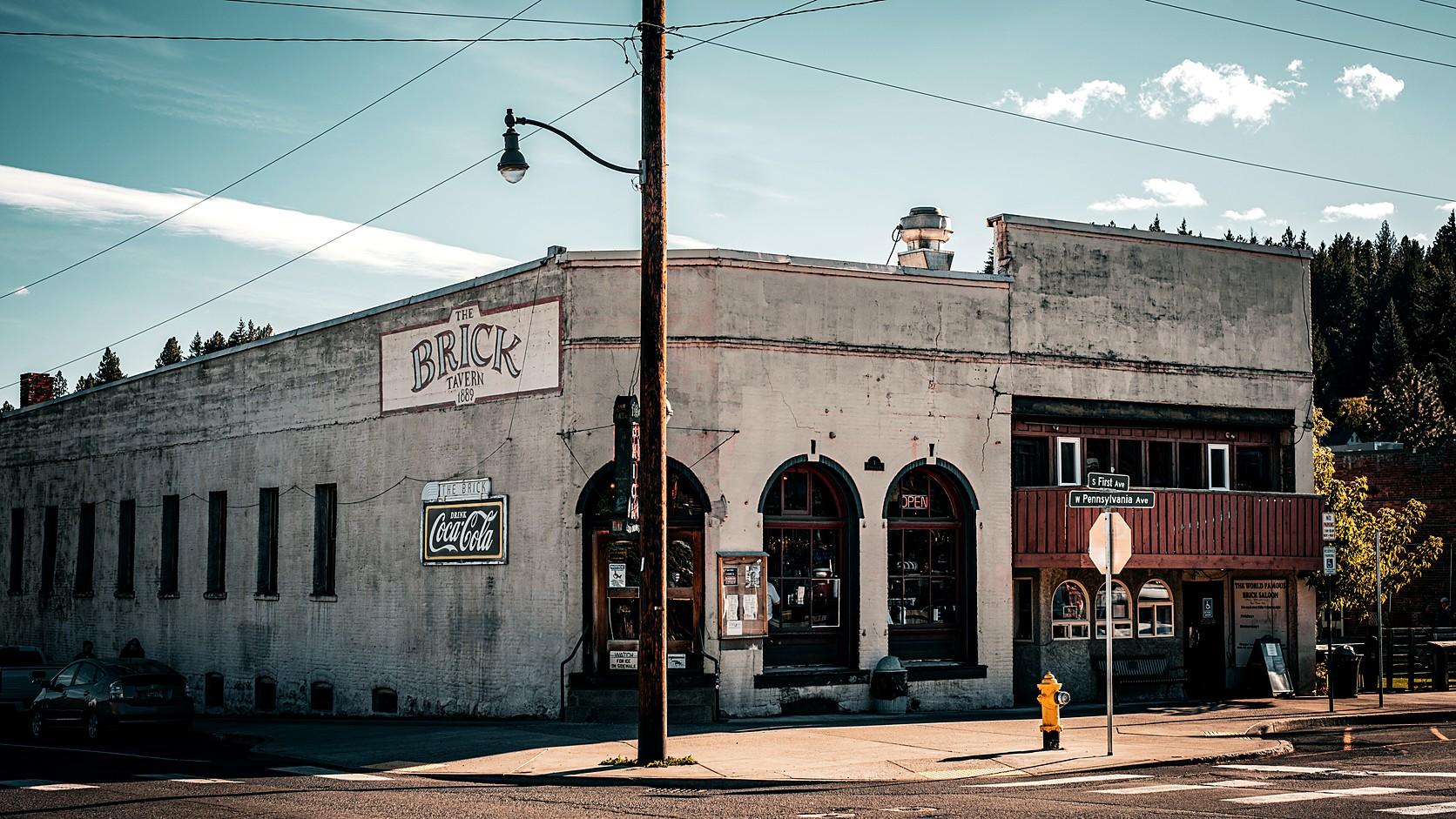
The Brick is a private business, and this is only what its own page says. The Brick Saloon, at 100 West Pennsylvania Avenue, lists hours of 11:30 a.m. to 10 p.m. Monday to Thursday, 11:30 a.m. to 1 a.m. Friday, 11 a.m. to 1 a.m. Saturday and 11 a.m. to 10 p.m. Sunday, as read on November 2, 2026. The phone is 509-649-2643. The page describes a historic saloon with a menu, online reservations and live music, and says nothing about age rules, so ask when you call. Hours are the owner's to change, particularly around holidays.
Its age is disputed in print. HistoryLink says the Brick Tavern was built in 1898. The 1978 National Register nomination dates the Brick to 1889 and says Italian immigrants Peter Giovanini and John Buffo built it as a tavern with brick from the Gunther mill in Cle Elum. It adds that the building served during Prohibition as a soft drink and ice cream parlor with a bowling alley in the basement. The nomination's description of the interior includes "backbar and 20-foot spittoon with running water under footrest." That is a 1978 description, and whether it all survives was not checked.
6. The Coal Mines Trail
The Coal Mines Trail follows the old Northern Pacific branch line that carried coal and residents between Cle Elum and Roslyn. The museum says the railway built the line to Roslyn in 1886 and on to Ronald in 1887. The rails are gone, and the museum describes the route as a historical walk with markers.
In Roslyn the museum says to park at the east end of Pennsylvania Avenue behind Old City Hall, near the Slag Pile, as the museum names it. From there the trail heads south toward Cle Elum or west along Washington Street, with railroad ties painted on the pavement, past the block-long brick company store to Runje Field and an information kiosk. The museum's map numbers 20 sites, from the dump of No. 7 Mine to a mule pasture. Its page gives no fee, pass or winter condition, so check with the museum before counting on bare ground in the cold months.
7. The Northern Exposure sites
Roslyn played Cicely, Alaska. HistoryLink says producers chose it in 1990 because it had north-country scenery, old buildings and an easier commute than Alaska, and that the series ran until 1995. The museum adds that it was shot in Roslyn in those years and posts a map of filming sites on its Northern Exposure page. It also notes that some interiors, including the Brick Tavern's and a doctor's house, were filmed in a studio in Redmond, so a visit to the real Brick will not match the set.
One detail comes from the museum's page. The Roslyn Cafe mural at Pennsylvania Avenue and 2nd Street was already there, the museum says, and the production added the apostrophe "s" to suit its Cicely set. The museum does not say whether the mural's lettering is still as it was.
Why a coal town east of the pass belongs on an Enumclaw list
Enumclaw sits among coal towns of its own, and Roslyn is the same story with the snow and the schedule turned up. The Black Diamond cemetery guide covers the ground over a mine on this side of the mountains, the Wilkeson coke ovens story covers the ovens that fed a Tacoma smelter, and the Washington ghost towns guide covers places that did not survive their industry. Roslyn did, barely. HistoryLink says its last mines closed in 1963 and that by 2008 the population was an estimated 992, down from 3,126 in 1910.
How do you get to Roslyn from Enumclaw in winter?
Roslyn is on the far side of Snoqualmie Pass, so the drive is an I-90 trip and the conditions are the pass's, not the town's. The Enumclaw to Yakima winter route guide explains why Chinook Pass is not an option once it closes for the season and what the chain signs on I-90 require. For the pass's own history, there is the story of the 1938 Ski Bowl at Snoqualmie Pass. HistoryLink puts Roslyn at 2,247 feet and says its winters are typically snowy; in the winter of 1915 to 1916 it recorded 385 inches. This article gives no drive time because none was taken from an official source.
Before you go
Call the museum at 509-649-2355 before you plan around it, and call the Brick at 509-649-2643 if hours matter. Check the Roslyn Cemetery Legacy Association's website for daylight-hours rules and events, and the Brick's own site for its hours on the day. Check road and pass conditions before leaving Enumclaw; the museum's directions come off I-90 at exit 80. The pages read for this article mention no pass or permit for any stop, but none of them says that none is needed, and none addresses the Coal Mines Trail in winter. Treat the cemeteries as places of burial, not scenery.
Story label: Original Story or Guide
Originally published: